


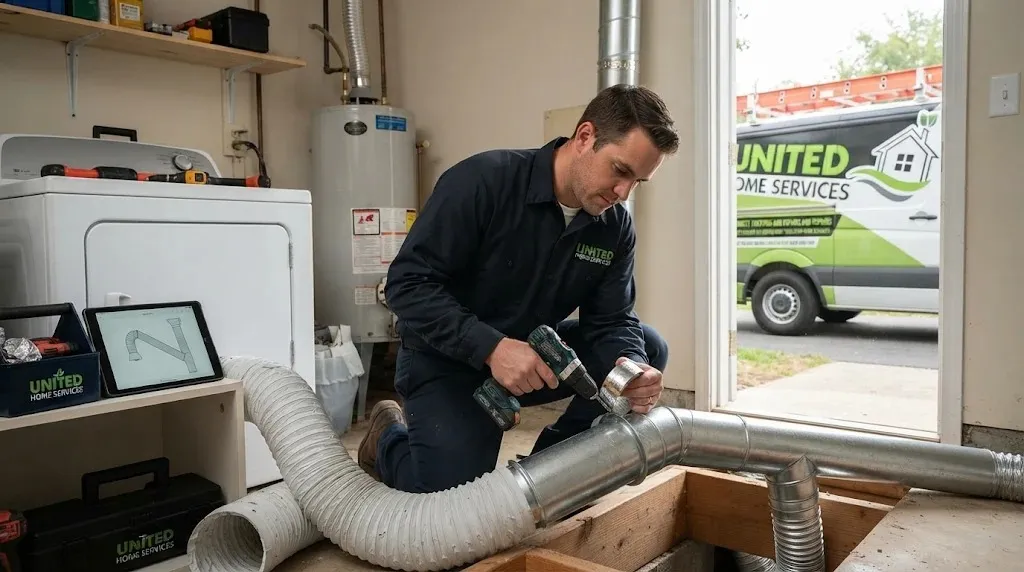

A dryer that takes too long to dry clothes may have more than a lint problem. Sometimes, the exhaust duct follows a route that is too long, contains too many bends, or passes through areas that make proper airflow difficult. In these situations, cleaning alone may not solve the issue. Dryer vent rerouting can provide a better solution by creating a shorter, more direct path for warm, moist air to leave your home.
For homeowners, the goal is not simply to move the vent opening. The entire exhaust route must be planned around airflow, building structure, appliance requirements, and exterior termination. At United Home Services, homeowners can explore professional dryer vent solutions designed to help identify installation problems and restore proper ventilation.
What Is Dryer Vent Rerouting?
Dryer vent rerouting involves changing the existing path of the exhaust duct between your dryer and the outdoor vent opening. Instead of sending air through an inefficient or poorly installed route, a technician plans a new configuration that allows exhaust air to travel outside more effectively.
For example, an older home may have a dryer vent that travels upward through a wall, crosses an attic, and exits through the roof. Depending on the home’s layout, a shorter route through an exterior wall may be possible.
Rerouting is different from cleaning. Cleaning removes lint and debris from an existing duct, while rerouting changes its physical layout. If the duct is damaged, excessively long, or incorrectly positioned, cleaning will not correct the underlying installation problem.
Signs Your Home May Need Dryer Vent Rerouting
Not every dryer problem requires a new vent configuration. However, certain symptoms can indicate that the existing route needs professional attention.
1. Clothes Take Too Long to Dry
If clothes regularly remain damp after a complete drying cycle, restricted exhaust airflow may be one possible cause. A long duct with several sharp turns can create resistance, making it harder for warm, moist air to escape.
Before assuming the route needs changing, the system should be checked for lint buildup, a blocked exterior vent, and appliance-related faults. If the duct layout is the underlying problem, rerouting may be worth considering.
2. The Vent Has Too Many Bends
Every turn in a dryer exhaust duct adds resistance to airflow. Several tight elbows can make an already long duct less effective and create areas where lint may collect.
A technician may recommend a different route that reduces unnecessary turns. The objective is to make the exhaust path as direct as the building structure reasonably allows.
3. The Existing Duct Is Excessively Long
Some dryer installations send exhaust air across a large portion of the house before reaching an outdoor opening. A longer route can make it more difficult for the dryer to move air through the system.
The acceptable duct length depends on the appliance manufacturer’s instructions, duct diameter, fittings, and applicable building requirements. If the existing configuration exceeds the permitted length, a shorter route may be necessary.
4. Your Dryer Vent Runs Through an Unwanted Area
A vent that passes through an attic, crawlspace, garage, or another difficult-to-access area may be challenging to inspect and maintain. These locations can also introduce concerns about disconnected joints, condensation, and hidden damage.
Dryer exhaust should discharge outdoors, not into an attic, crawlspace, garage, or wall cavity. If the current installation releases moist air into an enclosed area, its configuration needs to be corrected.
5. You Have Recently Remodeled Your Laundry Area
Home renovations can change the position of appliances, walls, cabinets, and utility connections. If the dryer has been moved, the old exhaust opening may no longer provide a practical connection.
A new vent configuration can help connect the relocated dryer to an appropriate exterior termination without relying on a crushed or excessively extended transition hose.
How Poor Vent Routing Affects Your Home
A poorly designed dryer vent does more than increase drying time. It can affect the appliance, surrounding building materials, and household safety.
When airflow becomes restricted, lint may accumulate inside the duct. Since lint is combustible, excessive buildup can contribute to a dryer fire hazard. The dryer may also operate at higher temperatures or require additional cycles to remove moisture from clothing.
Disconnected or leaking duct sections create another concern. Warm, moist exhaust air can enter wall cavities or attic spaces, potentially contributing to condensation and moisture damage.
These problems are why a vent route should be evaluated as a complete system rather than judged only by the visible hose behind the dryer.
What Does a Proper Dryer Vent Configuration Look Like?
A properly planned dryer exhaust system should move air outside through an appropriate, unobstructed route. Several installation details help support reliable performance.
Short and direct duct runs: The route should be as short and straight as the home allows. Unnecessary elbows, sharp turns, and excessive duct length should be avoided.
Smooth metal ductwork: Rigid metal duct with a smooth interior is generally preferred for permanent exhaust runs. The duct size and material must follow the dryer manufacturer’s instructions and applicable local requirements.
Secure connections: Duct sections should be properly connected and sealed. Fasteners that protrude into the duct can catch lint and should be avoided.
Proper exterior termination: The exhaust should discharge outdoors through an appropriate vent hood with a backdraft damper. Screens should not be installed across the termination because lint can collect on them.
Adequate support: Long duct sections need proper support to prevent sagging, separation, and unnecessary restrictions.
These details matter because a rerouted system should solve the original problem without creating new airflow or maintenance issues.
What Happens During a Professional Dryer Vent Rerouting Inspection?
Before changing the duct layout, a technician needs to understand why the current configuration is not working properly. The inspection should consider the entire path, not just the connection behind the dryer.
The process generally begins with checking the transition duct, visible connections, exterior vent opening, and signs of restricted airflow. Where accessible, the technician may inspect concealed sections to identify excessive bends, damaged ductwork, disconnections, or unsuitable materials.
Next, the home’s layout is assessed to determine whether a more direct route is practical. This includes checking for possible obstructions such as electrical wiring, plumbing, framing, and other building components before selecting a new exit location.
After the new configuration is planned, the work can involve removing or replacing unsuitable duct sections, installing an appropriate metal exhaust duct, securing connections, and fitting a suitable exterior termination.
The completed system should then be checked for airflow, secure connections, and proper exhaust discharge. Any new wall or roof penetration must also be sealed appropriately to help prevent water intrusion.
Is Dryer Vent Rerouting Better Than Installing a Booster Fan?
Not always. The right solution depends on the existing duct layout and the dryer manufacturer’s requirements.
If a vent is unnecessarily long or contains several avoidable turns, rerouting may address the underlying restriction. In some homes, however, the dryer location and building structure make a shorter route impractical.
An approved inline booster fan may be considered for certain long duct systems when permitted by the manufacturer and local requirements. It is not a substitute for correcting crushed ductwork, blocked sections, poor connections, or an unsuitable installation.
A professional assessment can help determine whether rerouting, repair, cleaning, or another approved solution is appropriate.
Why Professional Assessment Matters
Dryer vent rerouting can involve cutting through walls, working around concealed utilities, and creating a new exterior opening. A poorly planned change can damage wiring or plumbing, compromise weather protection, or leave the dryer with another inefficient exhaust route.
Homeowners should avoid making concealed duct modifications without understanding the building layout and applicable installation requirements. The final configuration must also meet the dryer manufacturer’s specifications and local building codes.
United Home Services offers dryer vent inspection, repair, and installation solutions to help homeowners identify ventilation problems. If your existing duct appears damaged or incorrectly configured, you can explore the company’s dryer vent repair and installation services to learn more about available support.
Frequently Asked Questions
1. When should a dryer vent be rerouted?
Rerouting may be necessary when the existing duct is excessively long, contains too many bends, follows an unsuitable path, or cannot provide proper exhaust airflow. It may also be needed after relocating a dryer or remodeling a laundry area.
2. Can cleaning fix a poorly routed dryer vent?
Cleaning can remove lint and debris, but it cannot shorten a duct, eliminate unnecessary bends, or correct an unsuitable installation. If the physical layout is the problem, rerouting or repair may be needed.
3. Can a dryer vent be rerouted through an exterior wall?
In many homes, an exterior wall can provide a practical route. However, the location must be checked for wiring, plumbing, structural components, and suitable clearance from nearby openings and air intakes. Local requirements and appliance instructions must also be followed.
4. How long can a dryer vent duct be?
There is no single maximum that applies to every dryer installation. The permitted length depends on the appliance manufacturer’s instructions, duct size, and the number and type of bends. Some building-code guidance uses a 35-foot baseline with reductions for elbows, but the specific installation requirements should always be checked.
5. Is it safe for a dryer vent to terminate in an attic or crawlspace?
No. A conventional vented dryer should discharge its exhaust directly outdoors. Releasing warm, moist air into an attic, crawlspace, garage, or wall cavity can create moisture problems and increase the risk of damage.
6. How do I know whether my dryer needs repair or rerouting?
A professional inspection can help distinguish between a blocked duct, damaged connection, appliance fault, and inefficient duct layout. Cleaning may solve a blockage, repair may correct damaged sections, and rerouting may be appropriate when the overall path needs to change.
Final Thoughts
A dryer vent’s route plays an important role in how effectively the appliance removes heat, moisture, and lint from your laundry area. Excessive duct length, unnecessary bends, damaged sections, and unsuitable termination points can all contribute to ventilation problems.
If cleaning does not resolve recurring airflow issues, the existing configuration may need a closer look. A professional inspection can help determine whether repair or a new vent route is the most suitable way to restore safe and reliable dryer operation.